
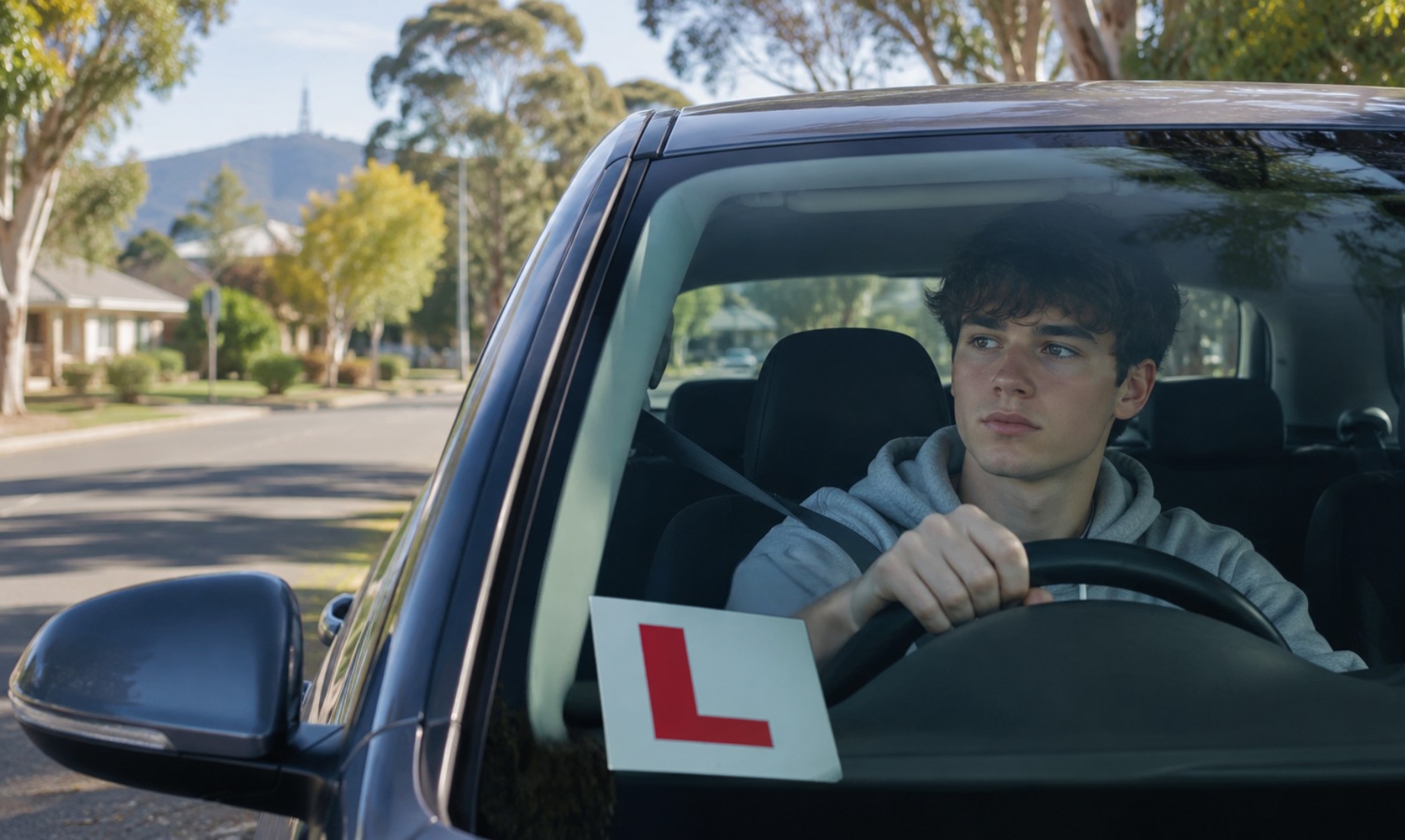
Getting your Ls in the ACT is the easy part. Working out what happens between then and your Ps is where most learners and their parents get stuck.
How many hours do you actually need? When can you sit the Hazard Perception Test? What’s the difference between CBT&A and the government driving test, and which one gets you there faster?
This guide walks through the entire ACT learner-to-provisional journey, using current requirements published by Access Canberra and ACT City Services, so you know exactly what’s ahead before you start.
ACT Learner to Provisional Licence: The 8 Stages
- Meet the age and eligibility requirements
- Complete an approved Pre-Learner Licence Course
- Pass the ACT Road Rules Knowledge Test
- Apply for your learner licence at Access Canberra
- Complete your learner period and supervised driving hours
- Sit the online Hazard Perception Test
- Prove your competence via CBT&A or the one-off practical assessment
- Apply for your ACT provisional licence
How long this takes depends mostly on your age, how often you drive, and which assessment pathway you choose. A 16-year-old starting today faces a minimum of 12 months. Someone who gets their Ls at 25 can be on their Ps in six.
How to Get Your ACT Learner Licence
To get your Ls in the ACT, you must be at least 15 years and 9 months old, complete a Pre-Learner Licence Course, pass the ACT Road Rules Knowledge Test, then apply in person at an Access Canberra Service Centre.
There are four steps.
1. Complete the Pre-Learner Licence Course
The Pre-Learner Licence Course is a 10-hour program covering safe driving behaviour, trip preparation, hazard recognition and the ACT licensing system. It runs across four modules:
| Module | Length | Covers |
|---|---|---|
| Drive to arrive | 4 hours | Risky decisions, speed, alcohol and drugs, impact on passengers |
| Prepare to drive | 1.5 hours | Vehicle checks, fatigue, emergencies, choosing a safe car |
| Drive time | 2.5 hours | Vulnerable road users, spotting hazards early, distraction, safety features |
| Drive rules and tools | 1 hour | Licensing steps, ACT road rules, building supervised hours |
To pass, you must attend all four modules and pass a 35-question multiple-choice assessment.
Worth knowing: most Canberra students do this at school, and some ACT schools deliver it free to Year 10 students as part of the curriculum. If you’ve left school, several community organisations run it at no cost — including Belconnen Youth Centre, MARSS Australia, Multicultural Hub Canberra, Northside Community Service, Woden Community Service and YWCA Canberra. Commercial driving schools also run it for a fee. Don’t pay before checking the free list.
2. Pass the ACT Road Rules Knowledge Test
The Road Rules Knowledge Test is a computerised test of ACT road rules and safety principles, sat through the same provider as your course.
Your pass certificate stays valid for two years. If you don’t apply for your licence within that window, you’ll need to sit it again the same applies later if you let your learner licence expire before reaching your Ps.
3. Apply at an Access Canberra Service Centre
Bring:
- Your Road Rules Knowledge Test pass certificate
- Proof of identity documents
- Proof you live in the ACT
- Payment for the licence fee
You’ll also sit a short eyesight test on the day.
The under-18 problem, solved: most teenagers don’t receive mail in their own name, which makes proof of residency awkward. Access Canberra allows a parent or legal guardian to attend with you and complete a written declaration confirming you live with them at an ACT address. Bring the parent, not just the paperwork.
4. Collect your temporary licence
Access Canberra issues a temporary licence on the spot. The physical card is posted and can take up to 21 business days — cards cannot be collected from a service centre. You’ll also receive your logbook and a set of L plates.
An ACT learner licence is valid for five years.
Rules Every ACT Learner Driver Must Follow
Holding your Ls does not let you drive alone. While on your learner licence, you must:
- Display L plates at the front and rear of the vehicle
- Have a person with a valid full Australian driver licence in the front passenger seat at all times
- Have zero alcohol and no drugs in your system
- Do not use a mobile device at all while driving — including hands-free and loudspeaker, and including while stopped in traffic but not parked
- Do not tow a trailer over 750kg Gross Vehicle Mass
- Do not exceed posted speed limits
- Follow the learner rules of whichever state or territory you’re driving in when interstate
Your supervisor has rules too
This is the part families miss. Your supervising driver must sit in the front passenger seat, hold a valid full Australian licence, and be under the zero blood alcohol limit with no drugs in their system. A parent who’s had two glasses of wine at dinner cannot legally supervise you home.
The demerit point limit
If your learner licence was issued or renewed after 1 January 2020, you have a 4 demerit point limit. Reach or exceed 4 points in a three-year period and your licence can be suspended for three months or disqualified. Learner licences issued before 1 January 2020 sit at the older threshold of 12.
That 4-point ceiling is tighter than it sounds. Touching your phone to skip a song costs 3 points. Using it for messaging or social media costs 4 — a single offence, and your Ls are gone. Failing to give way is 3. Speeding by 15–30km/h is 3.
Learner and provisional drivers also can’t elect a 12-month good behaviour period instead of suspension. That option is only available to full licence holders.
Unlike some states, ACT learner car licence holders face no passenger restrictions and no learner speed limit — you can drive to the posted limit, including 100km/h highways, as long as your supervisor is beside you.
These are licence conditions, not suggestions. Re-read the ACT Road Rules Handbook periodically as your experience grows; knowing a rule for a test and applying it in live traffic are different skills.
How Long Do You Need to Hold Your Learner Licence?
You must be at least 17 to move to a provisional licence, and you must first hold an active ACT learner licence for a minimum period:
| Learner circumstances | Minimum learner period |
|---|---|
| Learner licence issued before age 25 | 12 months |
| Learner licence issued at 25 or older | 6 months |
Your licence must stay active — not expired, suspended or disqualified — for that entire window. A suspension doesn’t pause the clock; time served under suspension doesn’t count toward the minimum.
This is only one requirement among several. You also need your supervised hours and a Hazard Perception Test pass.
ACT Learner Driving Hours: How Many Do You Need?
| Age when licence was issued | Supervised hours required | Night driving required |
|---|---|---|
| Under 25 | 100 hours | 10 hours |
| 25 or older | 50 hours | 5 hours |
Night hours count toward your total, not on top of it: 100 hours including 10 at night, not 110.
Access Canberra frames these hours as building genuine experience across different conditions, not a target to clear. Practise in rain, at night, in peak traffic, on the Parkway, in multi-storey car parks, and on roads you don’t know, the same easy loop until the logbook fills.
From experience: the learners who struggle at assessment are usually the ones whose 100 hours happened on twenty familiar streets. Variety beats volume.
→ ACT Learner Driving Hours Explained
Who Can Supervise a Learner Driver in the ACT?
Any person holding a valid full Australian driver licence can supervise you, including:
- A parent or family member
- A friend with a full licence
- An ACT Accredited Driving Instructor
Ordinary supervised driving counts one-for-one. Lessons with an ACT Accredited Driving Instructor earn extra credit under the 3-for-1 scheme. Hours driven with non-accredited instructors count one-for-one, same as a parent — so check accreditation before booking if the credit matters to you.
The ACT 3-for-1 Driving Instructor Credit, Explained
For every hour supervised by an ACT Accredited Driving Instructor, you receive three hours of logbook credit, capped at 10 instructor hours.
- 1 instructor hour = 3 credited hours
- 10 instructor hours (the maximum) = 30 credited hours
Beyond the cap, additional hours count one-for-one.
The bigger value of professional lessons isn’t the multiplier. A good instructor finds the weak spots you can’t see and teaches the specific competencies the ACT system assesses — which pays off whichever pathway you choose later.
→ ACT 3-for-1 Driving Instructor Hours Explained
What Is the ACT Learner Logbook?
Your logbook is the official record of your supervised driving, issued with your learner licence. It must accurately reflect both your total hours and your night hours.
If you’re doing CBT&A, your logbook also tracks progress against the 23 competencies as your instructor signs each one off, and includes the final assessment sheet you’ll hand over at Access Canberra.
Fill it in the same day you drive. Reconstructing eight months of driving sessions from memory the week before your appointment is miserable, and it’s the single most common avoidable delay we see.
→ ACT Learner Logbook Requirements Explained
Other ACT Courses That Count Toward Your Hours
Three optional road-safety programs give credit toward your driving-hour requirement:
| Course | Hours credited | Who’s eligible |
|---|---|---|
| Safer Driver Course | 20 hours | Learners under 25 when their licence was issued |
| Vulnerable Road User Program | 10 hours | All learner drivers |
| Learner Driver First Aid Program | 5 hours | Must have held Ls 3+ months; course completed after 22 November 2023 |
Together that’s 35 of your 100 hours — the most under-used shortcut in the ACT system.
Safer Driver Course: 2.5 hours of workshop plus a one-hour practical component with an ACT Accredited Driving Instructor, designed for two learners per vehicle. Before the practical part, you must have completed either 10 hours with an accredited instructor or 30 hours with a supervising driver.
Vulnerable Road User Program: self-directed learning plus a two-hour workshop on sharing the road with cyclists, motorcyclists and pedestrians.
Learner Driver First Aid Program: post-crash care. Several approved courses qualify, and the St John Ambulance Driver First Aid course is currently free.
Critical detail: when you claim these hours, bring a printed certificate or the original electronic copy. Photographs of certificates are not accepted. People get turned away at the counter for this.
The takeaway: the ACT system rewards a mix of supervised driving, formal learning and competency development — not just clocking 100 hours.
When Can You Take the ACT Hazard Perception Test?
You can sit the online Hazard Perception Test once you’ve held your Ls for three months. It tests how quickly and accurately you spot developing hazards, not your physical car control.
Your first attempt is free. If you don’t pass, you must wait 24 hours before retrying and a fee applies from the second attempt onward.
You need a pass regardless of which assessment pathway you choose. Sit it at the three-month mark rather than leaving it — learners who delay it often find it becomes the thing blocking an otherwise-ready application.
→ ACT Hazard Perception Test Guide
CBT&A vs the One-Off Practical Driving Assessment
Once your learner period, hours, and HPT are done, you prove your competence in one of two ways.
Option 1: Competency Based Training and Assessment (CBT&A)
Also called the logbook method, CBT&A is run by an ACT Accredited Driving Instructor who trains and signs you off against 23 competencies over a series of lessons, instead of a single test day.
Access Canberra sets a minimum of 7 lessons, and says most people need 10–15 depending on progress. Complete CBT&A successfully and you skip the government practical assessment entirely.
Option 2: The One-Off Practical Driving Assessment
Run by an ACT Government Licence Examiner in your own vehicle, this is a single assessment against the ACT’s published assessment standards, which are set out in legislation and free to read. Your supervising driver can use them during practice drives.
Book by calling Access Canberra on 13 22 81 and paying with VISA or MasterCard. You must be at least 17 on the day — book on or after your 17th birthday.
| CBT&A | One-Off Practical Assessment | |
|---|---|---|
| Run by | ACT Accredited Driving Instructor | ACT Government Licence Examiner |
| Format | Progressive, over multiple lessons | Single assessment day |
| Standard | 23 competencies | ACT assessment standards (legislated) |
| Minimum | 7 lessons | 1 attempt at a time |
| Vehicle | Instructor’s vehicle | Your own vehicle |
| If successful | No government test needed | Provisional licence issued |
Which is faster? Neither shortens the learner period, hours, or HPT. CBT&A spreads assessment across lessons and removes single-day pressure, but costs more in lesson fees. The one-off test is cheaper if you pass first go — and Access Canberra publishes that more than 50% of people fail their driving test, so factor in the real possibility of paying twice.
→ CBT&A vs One-Off Practical Driving Assessment
The 23 ACT Driving Competencies
CBT&A assesses far more than steering and braking. The 23 competencies span vehicle control, observation, speed management, turning, parking, reversing, lane changes, merging and managing risk around other road users — the full skill set for independent driving.
Aim to develop each one to the point where it holds up consistently in real traffic, rather than rushing sign-offs. Your instructor is signing a legal document saying you’re competent.
→ The 23 ACT Driving Competencies Explained
What to Bring to Your Practical Driving Assessment
Arrive 15 minutes before your appointment. If you’re more than 5 minutes late, you’ll be rebooked to the next available date and pay the fee again.
Documents
- Your ACT learner driver licence, or other accepted proof of identity
- Your completed logbook with all required driving hours accounted for
- Your Hazard Perception Test certificate
- Any checklist Access Canberra gave you
Vehicle requirements
You supply the vehicle, and it must:
- Be registered — an unregistered vehicle permit is not accepted
- Be clean inside — stained seats or excessive dirt will fail the check; use seat covers and floor mats
- Have clean, unobstructed windows
- Be roadworthy — tyres, brakes, brake lights and indicators all working
- Have working seatbelts
- Have a working centre-mounted park brake (electric or manual) that is accessible from the front passenger seat
- Be clear of loose items that could move around the cabin
- Display L plates front and rear
- Have at least a quarter tank of fuel
- Have working air-conditioning or heating
If your vehicle model was covered by the ACCC’s compulsory Takata alpha airbag recall, bring manufacturer documentation confirming the airbag has been replaced.
If the vehicle doesn’t meet these requirements, you cannot sit the assessment — you rebook and pay again. The centre park brake rule catches people out in cars with dash-mounted or awkwardly placed handbrakes. Check yours before booking, not on the morning.
Rescheduling or cancelling
Give at least 48 hours’ notice to reschedule (a change fee applies) or to cancel with a refund (a cancellation fee is deducted). Less than 48 hours and you lose the booking fee entirely.
During the assessment
To prevent a collision, your examiner may give instructions, take the steering wheel, or apply the handbrake. If that happens, it doesn’t automatically mean you’ve failed the whole assessment, but it will be recorded.
→ ACT Driving Test and One-Off Practical Assessment Guide
The Most Common Reasons ACT Learners Don’t Pass
Access Canberra names three mistakes as the most common:
- Not responding to speed changes, especially in school zones, high-pedestrian areas and construction zones. Canberra’s arterials change limits often, and the signage is easy to miss at speed.
- Not using head checks and mirrors before changing lanes or merging. Mirrors alone aren’t enough; the examiner is watching for a visible head turn.
- Overrunning the stop or hold line at stop and give way signs. A rolling stop is a fail.
All three are trainable. Practise them deliberately with your supervisor using the published assessment standards rather than memorising a test route — examiners don’t use a fixed route.
What Happens If You Don’t Pass the One-Off Assessment?
You don’t rebook immediately. The examiner explains why you were assessed as “not yet competent,” and Access Canberra emails you an assessment report detailing the areas needing work.
Practise those specific gaps with a supervising driver or an accredited instructor, then rebook. The minimum wait is 48 hours.
The report is genuinely useful — treat it as a targeted lesson plan rather than a rejection letter.
→ What Happens If You Fail the ACT Driving Test?
Automatic vs Manual: Does It Affect Your Licence?
Yes. Pass your assessment in an automatic, and your provisional licence carries an “A” condition. You can drive automatics unsupervised, but need a fully licensed supervisor to drive a manual.
To remove the condition before your full licence, you can either:
- Retake the assessment in a manual vehicle, or
- Request removal of the A condition after holding your provisional licence for 12 months
The A condition is removed automatically when you renew to a full licence after the three-year provisional period.
If you’ll never realistically drive a manual, the A condition costs you nothing. If there’s a manual work ute or a family car in your future, learning manual now is easier than retrofitting the skill later.
→ Automatic vs Manual Driving Lessons in Canberra
What Licence Comes After Your Ls?
Your age at issue determines where you start:
- Under 25 → P1 provisional licence (red P plates) for one year, then P2 (green P plates) for two years
- 25 or older → P2 provisional licence for the full three years
Either way, the provisional licence must be held for three years before you can move to a full licence.
P1 restrictions
On P1 you must also:
- Display red P plates front and rear, the correct way up
- Observe the peer passenger restriction: only one passenger aged 16–22 between 11pm and 5am (exemptions apply for work, school and family)
- Do not tow a trailer over 750kg
Breaching the late-night peer passenger rule costs 3 demerit points — and provisional drivers have the same 4-point ceiling as learners.
P2 restrictions
P2 drops the peer passenger rule and the towing limit, but keeps the green plates, the total mobile device ban, zero alcohol and drugs, and the 4 demerit point limit.
The discount nobody mentions
Keep a clean record — no demerit points, infringement notices or court-imposed traffic penalties — and you save money:
- Clean P1 year: 50% refund of the P2 licence fee (roughly a third of your total provisional fee)
- Clean P1 and P2: a further 30% discount on your full licence fee
Discounts are applied when you renew to your full licence. Once the provisional period ends you’ll get a renewal notice and can apply for your full licence online. A full ACT licence lasts up to 10 years.
→ ACT P1 vs P2 Licence Explained
ACT Learner-to-Ps Checklist
- Met the minimum age requirement (17+)
- Held your learner licence for the required period, unbroken
- Completed the required supervised driving hours
- Completed the required night-driving hours
- Kept your logbook accurately recorded
- Passed the Hazard Perception Test
- Collected certificates for any optional courses (printed or original electronic — not photos)
- Completed CBT&A or passed the one-off practical assessment
- Gathered proof of identity and payment (VISA or MasterCard)
Coming from an interstate or overseas licence? Extra requirements apply, and your prior driving experience may be recognised. Check interstate or overseas requirements before booking anything.
When Should You Start Professional Lessons?
There’s no rule requiring a set number of private hours before your first lesson — and starting earlier means fewer bad habits to unlearn.
The pattern that works best is structured instruction followed by regular supervised practice, rather than relying entirely on either. Lessons teach the technique; practice with a parent makes it automatic. Doing only lessons is expensive and slow. Doing only private practice tends to embed whatever your supervisor does wrong.
A practical sequence: a few early lessons to build correct fundamentals, bulk private practice through the middle of your learner period, then lessons again in the lead-up to CBT&A sign-off or your practical assessment.
ACT Learner Licence FAQs
How old do you need to be to get an ACT learner licence?
At least 15 years and 9 months, after completing the Pre-Learner Licence Course and passing the ACT Road Rules Knowledge Test.
How old do you need to be to get your Ps in the ACT?
At least 17, plus completion of your learner period, driving hours, Hazard Perception Test and chosen assessment pathway.
How many driving hours do ACT learners need?
100 hours including 10 at night if your licence was issued before age 25; 50 hours including 5 at night if issued at 25 or older.
Do driving instructor lessons count as three hours in the ACT?
Yes, with an ACT Accredited Driving Instructor, up to a maximum of 10 instructor hours — which caps out at 30 credited hours. Hours with non-accredited instructors count one-for-one.
When can you take the ACT Hazard Perception Test?
After holding your Ls for three months. Your first attempt is free.
Do all ACT learners have to take the government practical driving test?
No. Successfully completing CBT&A means you skip the one-off government assessment entirely.
What is CBT&A?
Competency-Based Training and Assessment — a logbook-based pathway where an ACT Accredited Driving Instructor trains and signs you off against 23 competencies over a minimum of 7 lessons, instead of one test day.
Can a parent supervise an ACT learner?
Yes, provided they hold a valid full Australian driver licence, sit in the front passenger seat, and have no alcohol or drugs in their system.
How many demerit points can an ACT learner get?
Four, if your learner licence was issued or renewed after 1 January 2020. Reaching or exceeding 4 points in a three-year period can mean a three-month suspension.
Can ACT learners have passengers?
Yes. ACT learner car licence holders have no passenger restrictions — the requirement is a qualified supervising driver in the front passenger seat.
How long does the ACT learner licence last?
Five years. If it expires before you reach your Ps, you’ll need to pass a new Road Rules Knowledge Test to renew.
Can I use my phone for GPS on my Ls?
Only if the device is mounted to the vehicle or connected by Bluetooth or cable, and requires no interaction of any kind while driving. Set your route before you move off.
Leave a Reply