
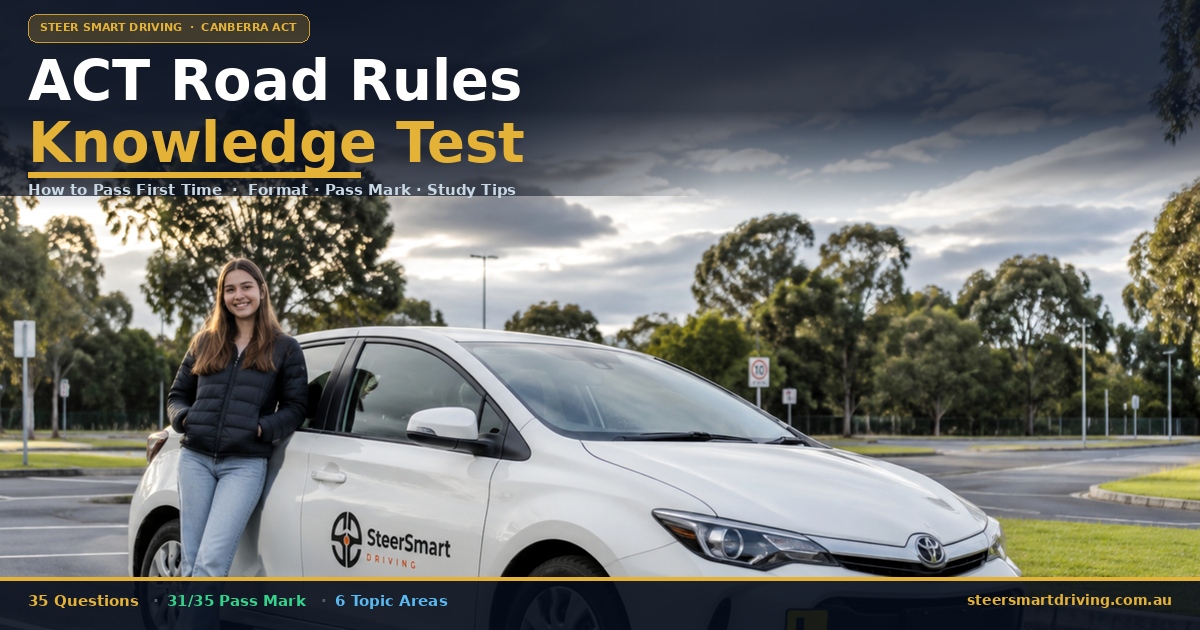
The ACT Road Rules Knowledge Test, also called the RRKT or DKT, is a computer-based assessment that every first-time learner driver in the ACT must pass before they can apply for an L-plate licence.
Here’s what most guides miss: the test has a specific structure, a specific pass mark, and specific topic categories. Once you understand the format, preparing for it becomes much more focused.
What Is the ACT Road Rules Knowledge Test?
The ACT Road Rules Knowledge Test (RRKT) is a 35-question, computer-based assessment that tests your understanding of ACT road rules and safe driving practices. You must answer at least 31 of the 35 questions correctly to pass. Questions are drawn from a bank of 378 training questions, so the specific questions you see on test day will vary.
The test is administered by your Pre-Learner Licence Course (PLLC) provider, not at an Access Canberra Service Centre. In most cases, learners sit it on the same day they finish the course.
You can’t book the Knowledge Test until you have completed the PLLC. That’s a hard requirement under the ACT Road Transport (Driver Licensing) Regulation.
How the Test Is Structured: The Six Topic Areas
This is where most guides stop short. They tell you how many questions are on the test. They don’t tell you what those questions actually cover.
The RRKT draws from two main question categories: Car General and Driving General. Within those, six topic areas are assessed:
| Topic Area | What It Tests |
|---|---|
| Alcohol, Drugs & Fatigue | Legal limits, effects on reaction time, fatigue management |
| Intersections & Give Way | Right-of-way, merging, and uncontrolled intersections |
| Speed Limits | School zones, variable limits, urban and rural defaults |
| Seat Belts & Restraints | Who is responsible for the mandatory use rules and child restraint types |
| Vulnerable Road Users | Rules protecting pedestrians, cyclists, and motorcyclists |
| Vehicle Knowledge | Legal limits, effects on reaction time, and fatigue management |
Quick Comparison RRKT vs Hazard Perception Test: The RRKT tests knowledge of road rules through multiple-choice questions. The Hazard Perception Test (HPT), which comes later, assesses your ability to visually identify developing hazards in real driving scenarios. The RRKT is the first test; the HPT is required before upgrading from a Learner to a Provisional Licence. The key difference: the RRKT is rules-based, the HPT is observation-based.
What You Need Before You Can Sit the Test
You cannot walk in and sit the RRKT off the street. Three things must be in place first.
1. Complete the Pre-Learner Licence Course (PLLC). This is a 10-hour, government-approved program covering road rules, crash statistics, and driver responsibility. The course is mandatory, with no exemptions, regardless of age or driving experience. Most providers include two free Knowledge Test attempts in the course fee, which typically runs $169–$185. Year 10 students: check with your school first. The PLLC is often delivered free as part of the ACT Year 10 curriculum.
2. Be at least 15 years and 9 months old. You can complete the course and even sit the test before this age. Both certificates stay valid for two years. Smart move: do the prep early, then walk into Access Canberra on your eligibility date ready to collect your L-plates the same day.
3. Be an ACT resident. Proof of Canberra residency is required at the Access Canberra stage. If you’re under 18 with no mail in your own name, a parent’s statutory declaration covers this.
Or maybe I should say it this way: the PLLC isn’t a box-tick before the real work starts. For a lot of learners, it’s where the actual road knowledge gets built, and that foundation directly affects how many questions you get right on test day.
[IMAGE: Young person sitting at a computer taking the RRKT at a testing centre in Canberra
How to Prepare and What Actually Works
There’s a common assumption that you can skim the ACT Road Rules Handbook the night before and be fine. The data says otherwise.
According to the ACT Government’s Road Ready program, the 17–25 age group is the highest-risk cohort for road crashes among new drivers in the ACT (ACT Government SafePlates, 2024). Learners who skip structured study and rely on general awareness tend to struggle with the specific wording of give-way questions and alcohol-limit scenarios, two areas that trip up a disproportionate number of first-time sitters.
Here’s what works:
Step 1: Read the ACT Road Rules Handbook in full. It’s a free PDF from the Access Canberra website. Every question on the RRKT is drawn from concepts in this document. Don’t read it passively read it looking for rules you didn’t already know.
Step 2: Use the ACT Government’s official practice test. The free practice test at safeplatestesting.act.gov.au mirrors the real test format. Work through it multiple times. When you get a question wrong, go back to the relevant section of the handbook and re-read it. Don’t just click past the correct answer.
Step 3: Focus your revision on your weak areas. Learners who’ve gone through the PLLC at Steer Smart report that intersections, default speed limits, and give-way at roundabouts are the areas where incorrect answers cluster. If you’re running short on study time, prioritise those.
Step 4: Book your test through your PLLC provider. Most providers, including those who deliver the PLLC as part of Steer Smart’s learner pathway, include two test attempts in the course fee. If you fail the first attempt, you can sit again without an additional charge.
Look, if you’ve done the PLLC and genuinely worked through the handbook, you’re not going in blind. The test rewards preparation. It doesn’t reward guessing.
ACT Road Rules Handbook (Access Canberra)
What Happens If You Fail
You can resit the RRKT as many times as needed. There’s no mandatory waiting period between attempts and no cap on the total number of attempts.
Most PLLC packages include two free attempts. Beyond those, each additional attempt incurs a fee charged by the provider. Confirm the cost before you book your course.
Here’s the thing: most people who fail the first time do so by a narrow margin. One or two questions in a single topic area. That’s fixable with targeted revision, not a full re-read of the handbook, but a focused 30-minute session on the specific section where the gaps are.
After You Pass, What Comes Next
Passing the RRKT earns you a Knowledge Test Pass Certificate. Keep it. This certificate, combined with your PLLC Course Completion Certificate, is what you present at Access Canberra when you apply for your Learner Licence. Both certificates are valid for two years from the date of issue.
At the Access Canberra Service Centre, you’ll also complete a brief visual acuity (eye) test administered by staff. Bring any prescription glasses or contact lenses you normally wear.
Once your licence is issued, you’re legal to begin supervised driving on ACT roads. Under 25? You’ll need to log 100 hours of supervised driving — including 10 hours at night — before you can apply for your Provisional Licence. Over 25? The requirement is 50 hours, with 5 at night.
This is where Steer Smart comes in. Our ACT-accredited instructors run lessons 7 days a week across Canberra. Each of your first 10 lessons counts as 3 credited logbook hours; that’s 30 hours recorded from 10 sessions, which makes a real dent in the 100-hour requirement.
FAQs
How many questions are on the ACT Road Rules Knowledge Test?
The test has 35 questions, drawn from a bank of 378. You need to answer at least 31 correctly, that’s a pass mark of roughly 89%.
What score do you need to pass the ACT knowledge test?
You must get 31 out of 35 questions right. You’re allowed a maximum of four incorrect answers across the full test.
Do I need to do a course before the ACT Road Rules Knowledge Test?
Yes. The Pre-Learner Licence Course (PLLC) is mandatory for all first-time ACT learner licence applicants. You cannot sit the RRKT until you have completed it.
How do I study for the ACT Road Rules Knowledge Test?
Read the ACT Road Rules Handbook (free PDF from Access Canberra), then work through the official practice test at safeplatestesting.act.gov.au. Please focus the revision on intersections, speed limits, and give-way rules—the most commonly failed topic areas.
What happens if I fail the ACT knowledge test?
You can resit without a waiting period. Most PLLC packages include two free attempts. Additional attempts after that incur a fee from your provider.
Leave a Reply